How to Sharpen a Chef Knife Without a Whetstone (Beginner Guide)
Your knife is dull, dinner is in an hour, and you definitely don't own a whetstone. Relatable. The good news is you've got more options than you think — some of them are sitting on your counter or hiding in a kitchen drawer right now.
Heads up: some links below are affiliate links — if you buy, we get a small cut at no extra cost to you.
Let me be honest upfront: a whetstone gives you the most control and the best edge. Full stop. But it also takes practice, patience, and honestly a bit of skill most beginners don't have yet. So while the purists are sharpening their $200 Japanese knives at a perfect 15-degree angle on a $80 King stone, the rest of us need practical options that work today. That's what this guide is.
Why Your Knife Gets Dull (And Why It Matters More Than You Think)
Before we fix the problem, let's understand it for like 60 seconds.
A knife edge is basically a super thin wedge of steel. Over time, that edge folds over, chips, or rolls — it doesn't just "wear away" evenly. When you drag your blade across a cutting board a thousand times, the microscopic tip of that edge bends sideways. That's why your tomatoes get squished instead of sliced. That's why you're pressing way too hard on a chicken breast.
Dull knives are also more dangerous. This is the thing nobody believes until they slice their finger trying to force a dull blade through a bell pepper. A sharp knife goes where you direct it. A dull knife wanders.
Most home cooks let their knives get way duller than they should before doing anything about it. If your Victorinox Fibrox — one of the most popular beginner chef knives around, retails for about $40 — has never been sharpened, it's probably performing at maybe 40% of its original capability right now. That's a waste of a genuinely good knife.
The Honing Rod: The Thing You're Probably Already Ignoring
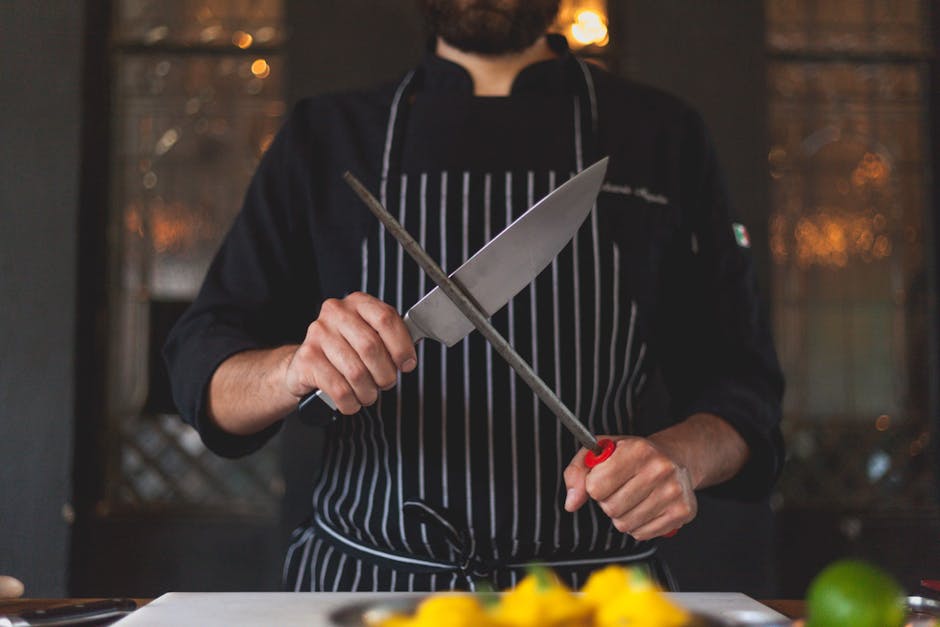
That long steel rod that came with your knife block? Use it. Seriously.
A honing rod doesn't sharpen your knife in the traditional sense — it realigns the edge. Remember that bent, folded tip we talked about? A honing rod straightens it back out. Done regularly, it keeps a sharp knife sharp for much longer between actual sharpenings. This alone can save you from needing to sharpen as often.
Here's how to actually do it:
- Hold the rod vertically, tip touching a folded dish towel on your counter.
- Place the heel of your blade near the top of the rod at roughly 15-20 degrees (for most Western knives, 20 degrees is fine — that's about the width of two stacked quarters).
- Sweep the blade downward and toward you, like you're trying to slice a thin layer off the rod.
- Alternate sides. Do 4-6 strokes per side.
That's genuinely it. The Victorinox honing steel runs about $25 and will last you literally decades. I've used the same one for seven years.
One warning: honing rods do nothing for a truly dull knife. If the edge is gone, alignment won't help. You need actual sharpening. But if you hone every 2-3 uses, you'll be amazed how long a sharp edge lasts.
The Coffee Mug Method (Yes, Really)
This one sounds ridiculous. It works.
Flip a ceramic mug upside down. See that unglazed ring on the bottom? That rough, matte ceramic? It's abrasive. It acts like a very fine sharpening stone. Not perfect, not precise — but functional in a pinch.
Here's what to do:
- Place the mug on a non-slip surface.
- Hold your knife at about 20 degrees to the bottom edge of the mug.
- Drag the blade forward in a smooth arc, heel to tip, like you're trying to slice a thin layer off the ceramic.
- Do 5-8 strokes per side. Alternate.
You'll see a small amount of gray residue — that's metal from your blade. That means it's working.
The results won't wow you. But if your knife is slightly dull and you need a quick fix for tonight's dinner, the mug method gets you there. I've done this at a friend's cabin with zero kitchen tools available and it made a real difference on a halfway decent 8-inch blade.
Don't use this method on expensive Japanese knives with harder steel. Too unpredictable without proper angle control.
Pull-Through and Electric Sharpeners: The Practical Middle Ground
This is where most people land, and honestly, for everyday home cooks, it makes total sense.
Pull-through sharpeners are manual, cheap, and consistent. You drag the blade through a V-shaped slot that holds carbide or ceramic abrasives at a fixed angle. No guesswork. No skill required. The Kitchell pull-through or the classic Zulay Kitchen model runs $15-25 and does the job for a standard Western knife.
The downside: they remove more metal than necessary. Use them too frequently and you're shortening your knife's lifespan. Use them when the knife is actually dull, not as a weekly habit.
Electric sharpeners are more aggressive and honestly way more useful for someone who owns nice knives but doesn't want to learn stone sharpening. The Chef'sChoice 4643 ($50-60) is my honest recommendation for beginners. It has three stages — coarse, fine, and strop — and consistently produces a sharp, usable edge. Not a razor's edge. A good working edge.
If you're willing to spend a bit more, the Work Sharp Culinary E2 runs about $80 and gives you slightly more control over the process. It's where I'd send someone who's serious about their knives but not ready to invest time in stones.
| Sharpener Type | Price Range | Best For | Downsides |
|---|---|---|---|
| Pull-through (manual) | $10–$25 | Budget cooks, occasional use | Removes a lot of metal |
| Electric (basic) | $40–$70 | Regular home cooks | Less precise than stones |
| Electric (quality) | $70–$120 | Serious cooks, multiple knives | Still not as good as stones |
| Coffee mug / sandpaper | Free–$5 | Emergency situations | Inconsistent results |
| Honing rod | $20–$40 | Maintenance between sharpenings | Doesn't fix a truly dull edge |
The Sandpaper Method for When You Want More Control
Sandpaper. Actual hardware store sandpaper. This works better than the mug method and gives you more feedback.
You want 220-grit to 400-grit wet/dry sandpaper. Lay it flat on a hard surface — stick it to a piece of wood or glass with a little water if you want it stable. Then use the same technique as the mug: blade at 20 degrees, sweep from heel to tip, alternate sides.
Start with the coarser grit (220) if the knife is genuinely dull, then finish with the finer grit (400) to refine the edge. A $5 pack of sandpaper from Home Depot will give you multiple sharpenings.
This method actually teaches you something. Because the sandpaper is flat and wide, you can feel whether you're holding a consistent angle. It's essentially a budget waterstone, and it's how I'd recommend beginners practice getting a feel for angle and pressure before spending money on a real stone.
One thing: this is slow. Plan on spending 10-15 minutes for a genuinely dull knife. That's fine. Worth it.
Frequently Asked Questions
Q: How often should I sharpen my chef knife if I cook every day?
A: Depends on your knife and what you're cutting. For a typical home cook using a Western knife on a wood or plastic cutting board daily, actual sharpening every 2-3 months is about right. Hone it every few uses. If you're cutting on glass or ceramic boards, sharpen more often — those surfaces destroy edges fast.
Q: Can I ruin my knife using these methods?
A: You can wear down the blade faster with aggressive pull-through sharpeners used too often. The mug and sandpaper methods are gentle enough that they won't cause real damage if you're careful about angle. Cheap electric sharpeners with misaligned slots are the biggest risk — they can create an uneven bevel if they don't match your knife's original angle.
Q: Does this work on Japanese knives?
A: Be careful. Japanese knives (like Global or Shun) typically use harder steel at a 15-degree angle. Most Western methods and pull-through sharpeners are calibrated for 20 degrees. Using the wrong angle regularly can actually round off the edge. For Japanese knives, stones really are the better call, or a sharpener specifically designed for them.
Q: What's the difference between sharpening and honing?
A: Sharpening removes metal to create a new edge. Honing realigns an existing edge that's bent out of shape. Think of honing like straightening a bent nail, and sharpening like cutting a new nail from scratch. You hone much more frequently than you sharpen.
Q: My knife is really, really dull. Will any of these methods fix it?
A: Probably yes, but it'll take effort. If your knife is significantly dull, start with the 220-grit sandpaper or a coarse pull-through sharpener. Do more strokes than you think you need. Test by slicing a piece of paper — a sharp knife should glide through cleanly without tearing.
Q: Is a $15 pull-through sharpener good enough for a nice knife?
A: Honestly, I'd say no for anything over $80. A Victorinox or Mercer knife? Sure, use whatever. A Wüsthof Classic or a Miyabi? Spend the extra $50 on something like the Chef'sChoice. The cheap ones aren't precise enough to respect a quality blade.
The Bottom Line
You don't need a whetstone to have a sharp knife. A honing rod for regular maintenance, a pull-through or electric sharpener for when things get genuinely dull, and the mug or sandpaper trick for emergencies — that's a complete system that'll keep most home cooks in good shape. Start with honing and do it consistently, because that one habit alone will cut your sharpening needs in half. And if you eventually decide you want to learn stone sharpening, great — but don't let the perfect be the enemy of a knife that actually cuts.