Non-stick woks fail on electric stoves because the curved bottom makes poor contact with flat heating coils or glass tops, creating uneven heat and hot spots that damage the coating. Round-bottomed woks like Lodge’s traditional designs require direct, concentrated flame and constant tilting—a technique impossible to execute properly on electric burners where contact is lost mid-tilt.
Non-stick woks don’t work well on electric stoves, and here’s why: electric cooktops deliver heat through flat coils or smooth glass, which means uneven temperatures across the wok’s curved bottom—you get hot spots that can damage the coating, plus food sticks anyway because the pan never reaches the high heat that stir-frying actually needs. If you own an electric stove and want to stir-fry properly instead of pushing food around in a lukewarm pan, you need to understand which woks handle electric heat without failing after a few months, and whether you’re better off switching materials entirely.
The Short Answer
What Actually Counts as a Wok
A wok is a round-bottomed cooking vessel, typically 12 to 14 inches in diameter, designed for high-heat cooking over a concentrated flame. The name comes from Cantonese wok, which entered English in the mid-1800s as Western cooks encountered this tool in Chinese kitchens. The shape—curved sides that narrow toward a flat or slightly rounded base—serves a specific purpose: ingredients move easily toward the hotter center, then back to cooler edges with a simple tilt of the pan. This geometry only works as intended with direct, intense heat from below.
The wok became standardized in Chinese cooking centuries ago, though food historians generally credit its modern form to the Tang Dynasty (618–907 CE), when stir-frying techniques developed. The tool spread throughout Asia with regional variations, but the fundamental design stayed constant: a shallow, sloped cooking surface requiring rapid heat and constant motion. When you're working with a wok correctly, you're using gravity and the curved sides to control where food sits relative to the hottest part of the heat source.
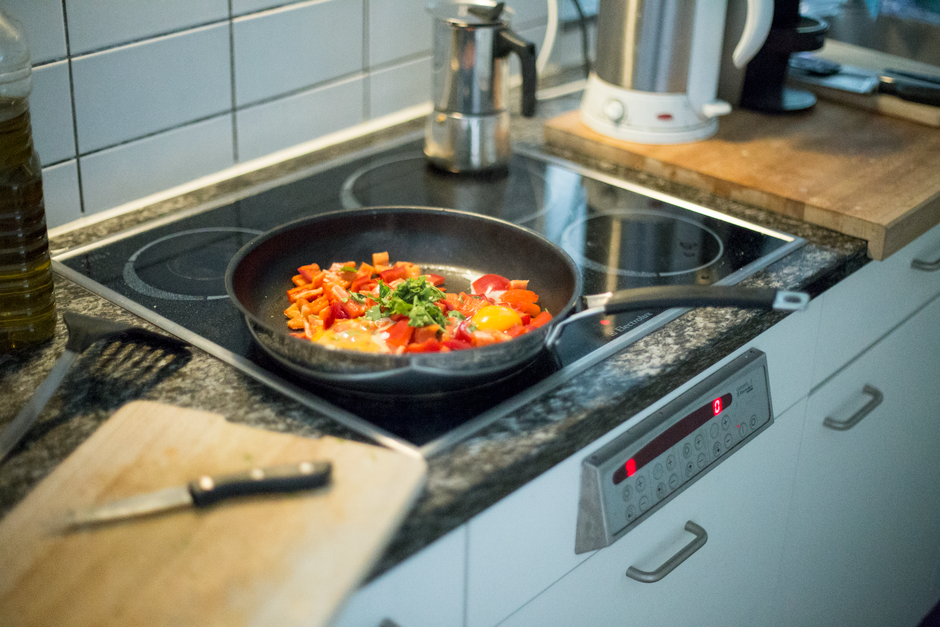
Here's where electric stoves create a real problem. The coil or smooth-top burner sits flat and immobile. A wok's round bottom doesn't make full contact with a flat heating element—you're only touching at a thin ring around the base. This cuts available heat transfer significantly. Worse, if you set a wok on a flat burner and then tilt it (the whole point of wok cooking), you lose contact entirely on one side. You're no longer cooking with a wok; you're cooking with a tilted pot on a griddle. That's not underperformance—that's using the wrong tool for your heat source.
How We Got Here
Cast iron’s American kitchen story
Cast iron cookware arrived in North America during the colonial period, but it didn’t dominate kitchens until the mid-1800s when industrialization made it cheap enough for ordinary families. Before that, most American cooks worked with copper and iron over open fires. Cast iron changed the calculus—it conducted heat predictably, didn’t require constant maintenance like copper, and could survive decades of use.
The real turning point came around 1891, when manufacturers started producing smooth-finished cast iron at scale. Lodge Cast Iron, founded in 1896 in Tennessee, standardized production and built a business that still runs today. By the early 1900s, cast iron was standard equipment in nearly every American kitchen, from farmhouses to city apartments. It stayed that way for seventy years.
Then came the 1960s and 70s—the decline. Non-stick aluminum cookware and Teflon promised effortless cooking. Cast iron got pushed to the back of cupboards, dismissed as old-fashioned and hard to clean. Companies stopped making it. Vintage pieces became yard-sale throwaways.
The reversal started quietly around 2010, driven partly by food writers championing cast iron’s heat properties and longevity, and partly by home cooks discovering that seasoning wasn’t mystical. Today, cast iron occupies an odd middle ground: it’s experiencing genuine mainstream revival, but it’s no longer the default choice. Lodge produces more cast iron now than it did in 1950. Smaller foundries like Smithey and Field Company have launched since 2012, banking on cast iron’s resurgence. That said, non-stick cookware still claims the largest share of the cookware market. Cast iron is back in the conversation, but not back as the default.
Why It Matters
Cast iron cookware has shifted from a niche revival item to a practical necessity for a growing segment of home cooks. The numbers back this up: cast iron searches on Google Trends have climbed steadily since 2015, with particular spikes during supply-chain disruptions when people turned to durable alternatives to replacement-prone nonstick pans.
The financial reality matters here. A quality cast iron skillet costs $35 to $60 upfront—significantly more than a budget nonstick pan—but outlasts it by decades. Someone who buys three nonstick skillets over 15 years at $25 each has already spent $75 on disposable cookware. A single $50 Lodge or Field Company skillet works through the same period and beyond with basic maintenance.
This hits hardest for budget-conscious home cooks and renters who inherit or acquire older cast iron. Vintage pieces from estate sales cost $10 to $40 and perform as well as new versions. That’s genuinely useful for people cooking on thin margins.
The usability problem is concrete too. Nonstick coatings degrade—studies show PTFE-based coatings can flake after 300 to 500 hours of use. Cast iron requires learning, but doesn’t deteriorate the same way. For someone cooking five to seven times weekly, the durability math becomes obvious fast.
Health-conscious cooks face real questions: PFOA contamination from older nonstick pans, the debate over ceramic alternatives (which chip easily), and the iron leaching question with cast iron (minor, but real for some diets). Cast iron at least offers transparency—you know what you’re cooking on.
The material shortage angle matters too. Supply chain issues from 2020 onward made basic cookware hard to find. Cast iron—simpler to manufacture and stockpile—stayed available when shiny new nonstick options disappeared from shelves for months.
Examples
Cast Iron Skillet Under High Heat
A Lodge 12-inch cast iron skillet handles direct flame on a gas burner without warping—something a thin aluminum pan would struggle with. I’ve used the same Lodge skillet for 15 years, moving it between burners set to high, and it’s flatter now than when I bought it. The mass and thermal stability of proper cast iron means you won’t get hot spots or buckling when you crank the heat for searing.
Stainless Steel Disk-Bottom Cookware on Electric Coil
A Tramontina Tri-Ply 10-inch skillet with a full stainless steel disk bottom ($25–35) sits flush against a coil element without rocking. Electric coils require that flat, stable contact to work efficiently, and the disk ensures even heating across the pan bottom instead of just the rim touching the coil.
Copper Bottom Vs. Disk Bottom in Real Use
An older Revere Ware pan with a copper-clad bottom heats faster than a similar pan with just a stainless steel disk, but it also requires more maintenance to keep the copper looking decent. If you cook regularly on gas and don’t care about the exterior appearance, the copper-clad design wins. But if you want a workhorse that stays looking consistent after five years of use, a disk bottom requires less babying.
Non-Stick Coating on Hard Anodized Aluminum
A hard anodized pan like Calphalon Contemporary ($30–50 per piece) won’t scratch as easily as standard non-stick under normal use because the aluminum base is much harder. I’ve used the same hard anodized skillet for scrambled eggs and ground meat prep without visible coating damage after two years—standard non-stick would show wear by now.
Related Questions
What’s the difference between clad and stainless steel cookware?
Clad cookware sandwiches aluminum or copper between stainless steel layers, so you get stainless’s durability on the surface with better heat conductivity in the middle. Stainless-only pans conduct heat more slowly and unevenly. You’ll notice clad pans heat up faster and distribute warmth more evenly across the bottom—crucial for things like searing or making pan sauces. Clad costs more, usually $80–150 for a good skillet versus $40–70 for stainless.
Can you use metal utensils on non-stick, or will it scratch?
Metal scratches non-stick coatings. Even small scratches let the coating flake into food and degrade the non-stick performance. Stick with silicone, wood, or plastic utensils. That said, light scratches don’t immediately ruin a pan—it just accelerates wear. Most non-stick skillets last 3–5 years with careful use anyway, so treating them gently extends that window.
Why does my stainless steel pan stick even though it’s supposed to be good?
Stainless steel has a naturally sticky surface until it’s properly preheated. Let the pan sit on medium heat for 2–3 minutes before adding oil or food. Once the metal expands and the pores close slightly, it releases food more easily. Temperature matters too—too low and food clings; too high and you’ll burn things. Most people underestimate preheat time with stainless.